Showing posts with label vertebral artery dissection. Show all posts

Friday, 11 September 2020

Risk Assessment of the Cervical Spine: A visit to the graveyard & directions for the future

That old chestnut the 'vertebral artery test' has been with us in Physiotherapy for nearly 4 decades, and yet still the arguments rage on about its clinical use. 

Confusion is never helpful in a clinical (or any) situation, so I've tried to make sense of the background, the logic and ongoing discussion regarding the use of 'the test that refused to die'.

Inspired by the recent debates within the literature, I've put together 3 SHORT FILMS.

Film I, discusses the history of the development and early use of the test. Film II uses some case studies to test the test, and then Film III, takes to the graveyard of old worn out tests, and attempts to offer some logical directions for the future for ALL clinicians working with neck pain, headache, dizziness and visual disturbances.

The key message, is that risk assessment of the cervical spine is relevant for ALL clinicians and NOT (as previously suggested) just for those who practice manual therapy. 

What we know from medico-legal cases is that delays to diagnosis and appropriate management can occur for a range of reasons. It may focus the mind to know that some medico-legal cases I've worked on, have involved assessment of the cervical spine (without intervention).

Hopefully, these films and the case studies contained within them will help to guide clinicians with their problem solving and clinical reasoning, in the quest for safe and efficient practice.


I. The Vertebral Artery Test - A SHORT FILM (Part I)

A short educational film about the long and tortuous history of the 'vertebral artery test', of interest to any clinician who manages patients with cervical spine issues.


II. The Vertebral Artery Test Part II: Risk assessment of the cervical spine


Part II of III, taking a look at the vertebral artery test from the perspective of NON manual therapists. Putting things into context using 4 case scenarios, with regard to risk assessment of the cervical spine. The video covers the umbrella concept of 'cervical arterial dysfunction'.


III. Cervical Spine Risk Assessment: Directions For The Future 

    A SHORT FILM (Part III)

Part III of the vertebral artery videos, takes us to the graveyard of tired old clinical tests, and moves on to offer some directions for the future for risk assessment of the cervical spine. A consideration of blood pressure, cranial nerve examination and sensorimotor testing is incorporated into the clinical case studies that provide background for the video/vlog.


Find more detail at: https://www.trustme-ed.com/lectures/cervical-arterial-dysfunction-moving-forward-with-alan-taylor/alan-taylor-part-3 Look out for the 'Cervical Spine: Risk & Rehabilitation online resources from Alan Taylor & Roger Kerry ... coming soon.

Author: Alan J Taylor is a writer and critic who tries to think about stuff . He works as a PhysiotherapistUniversity Assistant Professor and Medico-Legal expert witness whilst maintaining a small clinical work load. The views contained in this blog are his own and are not linked to any organisation or institution.  He once rode the Tour of Britain and worked as a cycling soigneur. He still enjoys riding a bicylce through the leafy lanes of Nottinghamshire and Derbyshire. In a World full of conflict and division ... like Bukowski, he 'writes to stay sane'.


Tuesday, 7 January 2014

Understanding cervical arterial dysfunction (CAD) for clinicians


The publication of the succinctly titled;

‘International framework for examination of the cervical region for potential of Cervical Arterial Dysfunction prior to Orthopaedic Manual Therapy intervention’ (Rushton, et al 2013)

... has highlighted the need for manual therapy clinicians to be cognisant with cervical arterial dysfunction (CAD)


BUT what is that? … and what does it mean to clinicians?


Let us start ... by dealing with what it is NOT
Dissection of an artery
  1. Cervical arterial dysfunction is NOT cervical arterial dissection! That may seem obvious to some, but both acronyms are now in common usage and therefore some confusion may arise. The term dissection is specific to dissection events (see image) and therefore narrow. Cervical arterial dysfunction is a broader term which is all-encompassing of a range of pathologies which may affect the cervico-cranial vasculature. 
  2. CAD is NOT vertebro-basilar insufficiency (VBI). However, it does incorporate it - as one of the component parts of a wider system based approach to thinking about haemodynamics and ischaemia
  3. Above all, CAD is NOT (in isolation) dissection of the vertebral artery. That would simply be a continuation of the narrow thought process which lead us to believe that a single test i.e. the vertebral artery test, could somehow allow us to decide whether cervical manipulation was ‘safe’ or not! That outdated concept has thankfully been de-bunked once and for all, as we move closer to science based practice.

So what is cervical arterial dysfunction then…?


CAD is a consideration of ALL of the potential arterial dysfunctions, which may present to, or ensue from a manual therapy intervention.
CAD is simply a way of thinking about an age old problem in a different way, and more importantly asking ourselves different questions about this familiar problem – linked to RISK and cervical spine management. The emphasis has moved firmly away from just ‘manipulation’, into a consideration of movement per se. This clearly widens the thinking into a consideration of ASSESSMENT (which incorporates movement) as well as intervention, which may incorporate ANY form of manual therapy or exercise prescription. This is then combined with a consideration of ALL of the potential structures and vascular 'dysfunctions'. Thinking is no longer constrained by one structure or pathology.

So why the shift from VBI and vertebral artery dissection …?

Well first of all, there is a lot more to the cervical vasculature than the vertebro-basilar system and there is a lot more to the range of pathologies than just dissection. Dissection or damage to the intimal wall of a vessel is a commonly cited vascular ‘injury’ thought to be associated with cervical spine manipulation in particular. However, an understanding of the basic science of haemodynamics allows us to incorporate many more conditions and pathologies into the paradigm. 

There are a range of reasons why blood vessels may be compromised in the cervico-cranial region, from pre-existing underlying anatomical anomalies, vasospasm, atherosclerotic disease, through to arteritis (i.e. temporal). All of these may lead in different ways, to potential ischaemia which may manifest and a variety of ways, ranging from PAIN, through to blindness, stroke or at worst death.

 Some direction for clinicians:
  • Develop an understanding that there is more to cervical spine risk assessment than a consideration of ‘VBI’ or dissection of the vertebral artery.
  • Consider a ‘systems based’ approach, incorporating the whole cervical vascular system, including the carotid vasculature (and branches) and the whole range of potential pathologies (NOT just dissection).
  • Develop awareness, that whilst commonly cited vascular risk factors have not been shown to be associated with dissection pathologies, they are strongly correlated with atherosclerosis, hypertension and stroke … This is ‘system based thinking’.
  • Develop increased awareness that neck pain and headache may be the early signs of pre-existing vascular dysfunction.
  • Develop an index of suspicion for cervico-cranial vascular pathology, particularly in cases of acute trauma or non-resolving/worsening conditions.
  • Enhance subjective/objective examination by including vascular risk factors such as hypertension, and procedures such as blood pressure, cranial nerve testing and eye examination.
  • Consider carefully the ORDER of your examination in the presence of potential vascular ‘red flags’.
  • Expand manual therapy teaching and practice to include haemodynamic principals and their relationship to movement, handling, anatomy and biomechanics.


Despite all this … when all is said and done, the 64m dollar question still seems to be … Should clinicians perform a ‘vertebral artery test’?

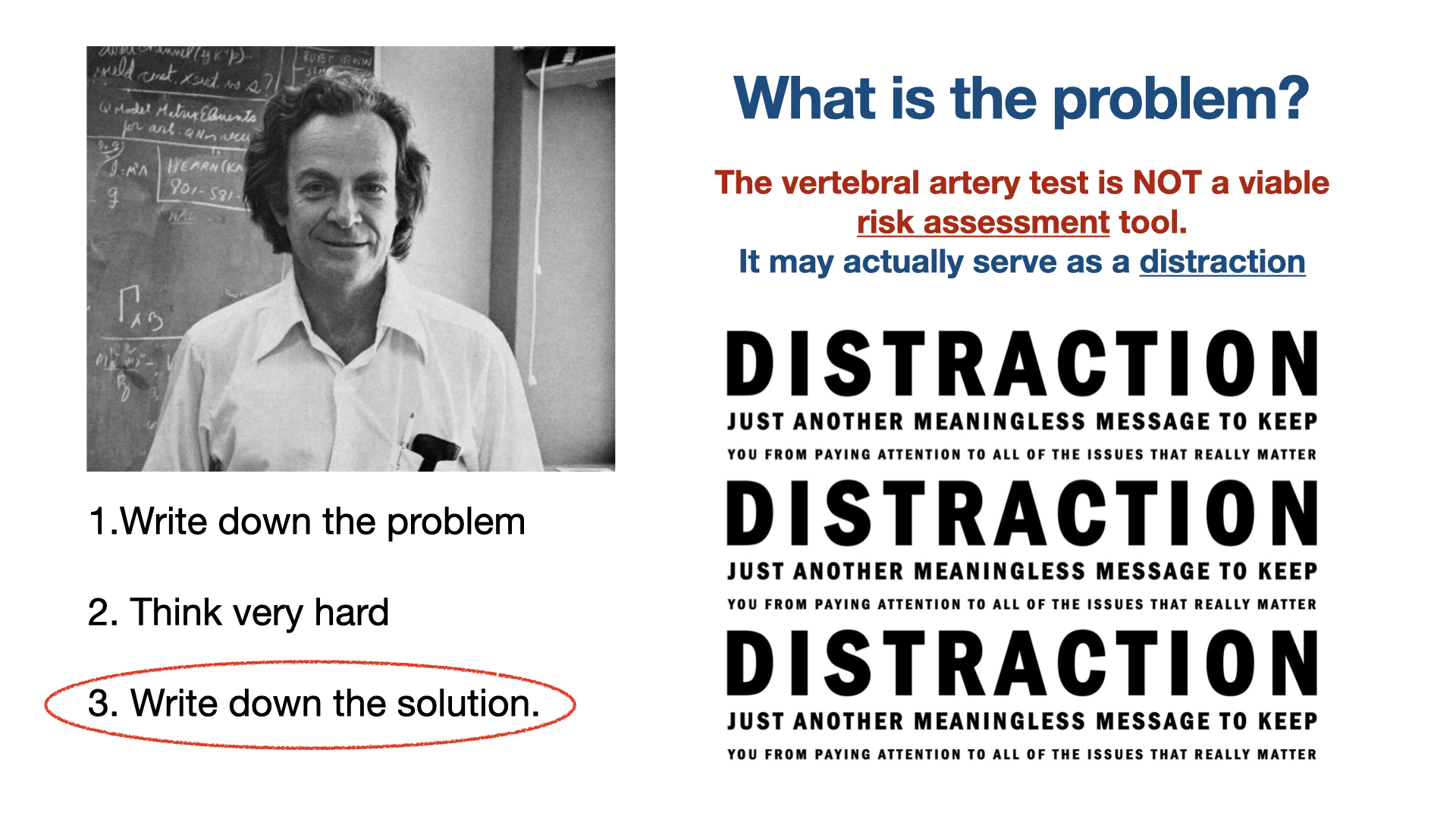
Answer … there is little to support it's use as a stand alone test. Its sensitivity and specificity are very poor AND its clinical utility is of little value. It has been argued that it should be retained from a 'medico-legal' perspective, but that contention would most likely be destroyed by any half competent barrister.

Note - that cranial nerve and blood pressure testing are additional objective measures to incorporate into the physical examination. Both feature prominently in the IFOMPT framework.

 
For a more detailed description of this paradigm change see:
A ‘system based’ approach to risk assessment of the cervical spine prior to manual therapy (Taylor & Kerry 2010) http://www.sciencedirect.com/science/article/pii/S1746068910000532

‘International framework for examination of the cervical region for potential of Cervical Arterial Dysfunction prior to Orthopaedic Manual Therapy intervention’ (Rushton, et al 2013)


Wednesday, 9 October 2013

Cranial nerve testing & cervical spine risk assessment – A ‘no brainer’!


Straw poll anyone...?


Hands up manual therapists ... if you would perform a neurological examination (upper limb/lower limb/UMN), if a patient’s subjective history indicated that you should………..
GOOD, that’s pretty much 100% of you then?

Hands up ... if you would perform a cranial nerve examination if a patient’s subjective history indicated that you should…. Mmmm, I suspect that result is well below 100% (amongst physiotherapists for sure...!)

http://www.medical-artist.com/cranial-nerves.html
Medical illustrations of the cranial nerves by Joanna Culley of Medical-Artist.com

For decades, manual therapists worldwide, have talked about the importance of the D’s (dizziness, drop attacks, diplopia, dysarthria and dysphagia) and N’s (numbness, nausea and nystagmus) when taking a subjective history in patients’ suspected of having ‘vertebrobasilar insufficiency’ (VBI). 

In the same way physiotherapists in the UK, were traditionally taught to perform a thorough neurological examination in upper and lower limbs, in cases of suspected neurology or upper motor neurone dysfunction.

So why did we never really get to grips with cranial nerve examination in suspected cervico-cranial neurology? There’s no point in looking back really (though a few educationalists might shift awkwardly in their seats), the plain stark fact is that we have been missing a trick! The D’s and N’s we diligently worried so much about, were simply subjective manifestations of cranial nerve dysfunctions linked to brain ischaemia.

Frankly, it is that simple. A well-performed CN examination may provide key information to assist in the clinical reasoning, risk assessment and triage process. That is why it appears as a prominent part of the 2012 IFOMPT International Framework for Examination of the Cervical Region for potential of Cervical Arterial Dysfunction prior to Orthopaedic Manual Therapy Intervention ... A somewhat long winded name, for what is essentially a cervical spine risk assessment document.

http://tinyurl.com/bpkj2xw
 

The IFOMPT document was achieved via protracted International consensus and represents the best level of evidence we currently have. Therapists would be wise to avail themselves of the key recommendations for practice contained in the document. Some key points are mentioned below, BUT … the author advises reference to the complete document for balance.

Implications for practice


There are serious conditions, which may mimic musculoskeletal (MSK) dysfunction in the early stages of their pathological progression.
1.     Cervical arterial dysfunction
2.     Upper cervical instability

This basically means that manual therapists need to possess the tools by which they can make informed decisions about risk, from a subjective and objective perspective.

A comprehensive list of risk factors and differential diagnosis table is contained within the IFOMPT document (pp 13-14). There are also some useful case histories which help to put this into perspective (pp 15-16)
  

Clinical decision-making


Some important points are made with regard to decision making for the physical examination are also highlighted.

“Based upon the evaluation and interpretation of the data from the patient history, the physical therapist needs to decide:

·Are there any precautions to orthopaedic manual therapy OMT?
·Are there any contraindications to OMT?
·What physical tests need to be included in the physical examination?” (IFOMPT 2012)

The above are generally normal practice for most experienced manual therapists. However, the following two items, frankly should be normal practice also, but are explicit in the document.

What is the priority for these physical tests for this specific patient? What is the order of testing and to which tests should be completed at the first visit?

·Do the physical tests need to be adapted for this specific patient?" (adapted from IFOMPT 2012)

Implications for clinicians


Well simply, there is an International guidance document, which suggests you need to think carefully about HOW TO PROCEED with your physical examination. The clinician may be wise not to launch into a ‘routine examination’ and this has obvious medico-legal implications.


What does that mean practically?

Essentially, that clinicians should, from a detailed subjective history and sound clinical reasoning, be able to adapt their clinical examination (and order of) accordingly. This may, based on the findings of the subjective history include a consideration of upper cervical instability, high or unstable blood pressure and cervical arterial dysfunction. 

A series of possible actions are described in full, in the IFOMPT document (pp 18-21)

I will draw your attention to the specific sections on cranial nerve examination and blood pressure testing (which I cover in a separate blog), which may form part of the physical examination.


Clinical pearls


1.     Cranial nerve testing is an essential part of physical examination in the presence of neurovascular signs and symptoms in the cranio-cervical region

2.     Physical examination involves movement and that alone may cause neurovascular compromise

3.     Remember, this is no longer just about the vertebral artery – USE SYSTEM BASED THINKING

4.     Cases of arterial compromise have been documented (usually as medico-legal cases) linked to EXAMINATION only! 

5.     Remember, this is no longer just about just arterial dissection

6.     Clinicians should be aware of the range of arterial pathologies and their potential links to movement based therapies NOT JUST MANIPULATION!

7.     GOOD NEWS …Physiotherapists are currently World leaders in guiding practitioners toward safe, evidence based practice and risk assessment in the cervical spine

It is in your interest as a clinician (at every level) to be familiar with IFOMPT 2012


References

International Framework for Examination of the Cervical Region for potential of Cervical Arterial Dysfunction prior to Orthopaedic Manual Therapy Intervention (2012) http://www.ifompt.com/site/ifompt/files/pdf/Standards%20Committee/Standards%20Committee%20Documents//IFOMPT%20Examination%20cervical%20spine%20doc%20September%202012%20definitive.pdf
Taylor AJ, Kerry R (2010) A systems based approach to risk assessement of the cervical spine prior to manual therapy. International Journal of Osteopathic Medicine 13(3):85-93

Kerry R, Taylor AJ (2009) Cervical arterial dysfunction: knowledge and reasoning for manual physical therapists. Journal of Orthopaedic and Sports Physical Therapy 39(5):378-387

Education 

Anatomy Video (Armando Hasudungan)


Cranial Nerves - functions and disorders 
 
Cranial nerves - http://prezi.com/l-chg-rsdkf5/cranial-nerves/

Physiotherapy UK Congress 2013 -  http://prezi.com/yv9w6ixyjbrn/cervical-spine-risk-assessment-rehabilitation-guidance-for-safe-effective-clinical-practice/

One minute medical school - Cranial Nerves  

Cranial Nerve OSCE examination 

Two minute CN Examination

Author

Alan J Taylor  - is a medico-legal expert witness, in the field of clinical negligence related to manual therapy and stroke.

He works as an Assistant Professor in Physiotherapy and Sports Rehabilitation & Exercise Science at the University of Nottingham. 

https://twitter.com/TaylorAlanJ