Showing posts with label physical therapy. Show all posts

Thursday, 14 January 2021

Making Sense of the Cranial Nerves: 3 SHORT FILMS

Cranial nerve testing should be within the skill set of ALL clinicians who treat neck, head and orofacial presentations.

Most clinicians are well versed and confident with neurological testing of the upper and lower limbs as well as upper motor neuron tests. However, when it comes to what is arguably the riskiest of anatomical regions, the head and neck ... there appears to be a strong suggestion that history and education have not prepared physiotherapists well for this.

The harsh reality is that many #Physios report that:

1. They were not taught CN’s at University

2. If they were, they are a little rusty with application and interpretation

3. It’s not something they do very often, and the tests are really hard to recall

Indeed a recent Twitter poll revealed that 53% of respondents suggested that they had not been taught these skills at University. Of those that had, over 50% suggested that they were not comfortable with applying them and interpreting the tests in clinical practice.

This is perhaps a little alarming for a profession which is championing the concepts of FCP and ACP roles within healthcare. There is a mismatch here, and a clear need to improve understanding, education and competencies. But it is not just FCP’s & ACP’s who need these skills. They are easily attainable for any clinician, and can easily be understood and applied from UG level. BUT DON'T FEEL BAD ... I think perhaps the educational system in some places (not all), has let us all down, and
I agree entirely, the CN's are a bit complex and do at first provide a challenge to learn.

The missing links are often context, understanding, working knowledge and the application of clinical reasoning.

That is why I've put together 3 short films in the 'Fireside CPD Sessions' series, to help make sense of the cranial nerves, their functions + when and how we might test them.

An opportunity to get to know the cranial nerves and their functions from a clinical reasoning perspective.


This short film is designed to introduce the cranial nerves and consider the subjective questions (that we often don't ask) that might lead us to test them in the clinical situation.


FILM 3. How to remember the Cranial Nerves: A Function Based Approach - A SHORT FILM This short, tongue in cheek, ‘Fireside CPD’ film, draws upon story telling, and offers an inventive and fun method of recalling the FUNCTIONS of the cranial nerves. Pull up a chair, open a bottle, or make a nice cuppa and enjoy a fun and inventive way to remember the cranial nerves based on FUNCTION.


These films should provide a solid base for all clinicians who wish to familiarise themselves with the cranial nerves, gain a basic understanding of their function, AND develop an easy method for recalling the tests.

ENJOY! For more on the Cranial Nerves, go to: http://alteredhaemodynamics.blogspot.... For a 'Cranial Nerves Country Song' ... go to: https://www.youtube.com/watch?v=WgjyE... Look out for 'Cervical Spine: Risk & Rehabilitation for Clinicians' ONLINE COURSE (2021)

Friday, 11 September 2020

Risk Assessment of the Cervical Spine: A visit to the graveyard & directions for the future

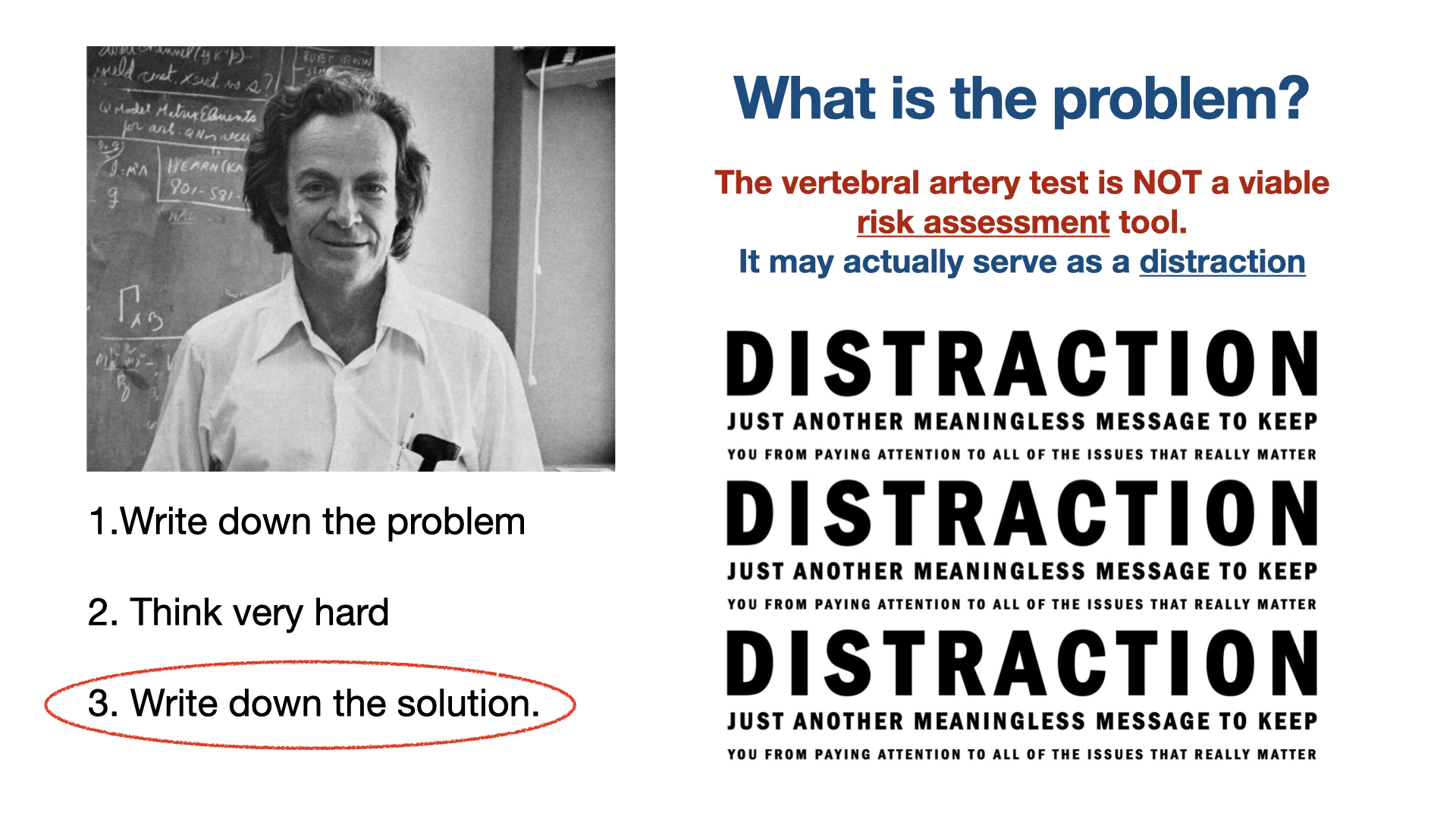
That old chestnut the 'vertebral artery test' has been with us in Physiotherapy for nearly 4 decades, and yet still the arguments rage on about its clinical use. 

Confusion is never helpful in a clinical (or any) situation, so I've tried to make sense of the background, the logic and ongoing discussion regarding the use of 'the test that refused to die'.

Inspired by the recent debates within the literature, I've put together 3 SHORT FILMS.

Film I, discusses the history of the development and early use of the test. Film II uses some case studies to test the test, and then Film III, takes to the graveyard of old worn out tests, and attempts to offer some logical directions for the future for ALL clinicians working with neck pain, headache, dizziness and visual disturbances.

The key message, is that risk assessment of the cervical spine is relevant for ALL clinicians and NOT (as previously suggested) just for those who practice manual therapy. 

What we know from medico-legal cases is that delays to diagnosis and appropriate management can occur for a range of reasons. It may focus the mind to know that some medico-legal cases I've worked on, have involved assessment of the cervical spine (without intervention).

Hopefully, these films and the case studies contained within them will help to guide clinicians with their problem solving and clinical reasoning, in the quest for safe and efficient practice.


I. The Vertebral Artery Test - A SHORT FILM (Part I)

A short educational film about the long and tortuous history of the 'vertebral artery test', of interest to any clinician who manages patients with cervical spine issues.


II. The Vertebral Artery Test Part II: Risk assessment of the cervical spine


Part II of III, taking a look at the vertebral artery test from the perspective of NON manual therapists. Putting things into context using 4 case scenarios, with regard to risk assessment of the cervical spine. The video covers the umbrella concept of 'cervical arterial dysfunction'.


III. Cervical Spine Risk Assessment: Directions For The Future 

    A SHORT FILM (Part III)

Part III of the vertebral artery videos, takes us to the graveyard of tired old clinical tests, and moves on to offer some directions for the future for risk assessment of the cervical spine. A consideration of blood pressure, cranial nerve examination and sensorimotor testing is incorporated into the clinical case studies that provide background for the video/vlog.


Find more detail at: https://www.trustme-ed.com/lectures/cervical-arterial-dysfunction-moving-forward-with-alan-taylor/alan-taylor-part-3 Look out for the 'Cervical Spine: Risk & Rehabilitation online resources from Alan Taylor & Roger Kerry ... coming soon.

Author: Alan J Taylor is a writer and critic who tries to think about stuff . He works as a Physiotherapist, University Assistant Professor and Medico-Legal expert witness whilst maintaining a small clinical work load. The views contained in this blog are his own and are not linked to any organisation or institution.  He once rode the Tour of Britain and worked as a cycling soigneur. He still enjoys riding a bicylce through the leafy lanes of Nottinghamshire and Derbyshire. In a World full of conflict and division ... like Bukowski, he 'writes to stay sane'.


Wednesday, 4 July 2018

A sudden rush of blood to the head: Why words really do matter in EVERY domain


So ... it seems there has been a proper furore and rush of blood to the heads (sorry ... that was a feeble attempt at a haemodynamics link ) of some folk, over the use/choice of a word in the @thecsp (UK) PR campaign ‘Love Activity, Hate Exercise’. 

The whole affair highlights the incredibly emotive power of words/word choice and how interpretation is entirely dependent on perspective and context. 

Love activity, Hate exercise?

Image: CSP http://www.csp.org.uk/professional-union/practice/public-health-physical-activity/love-activity-hate-exercise
A similar attempt at influencing opinion was run by the American Heart Association  @american_heart (USA) in 2017, they called it ‘5 Steps to Loving Exercise ... Or At Least Not Hating It’. That blog campaign successfully conveyed the message that not everyone likes #Exercise and gave some practical tips that were designed to help non-exercisers begin to #LoveActivity or even exercise.

As well as promoting movement and physical activity (and exercise), one of the key messages of both campaigns seems to be that #Exercise adherents and promoters (I would place myself into that category) ... may find it challenging to see things from a non-exerciser's perspective ... The suggestion being that anything that helps facilitate a greater understanding of the patients perspective, and helps start a conversation, can only be helpful, surely?

That said, HATE is an incredibly emotive word and I've always encouraged my kids never to use it ... so I see the antipathy to its use. However, I can see the value in backing the #LoveActivity campaign, because if a patient uses the 'hate' word (and they do) as therapists we have to have the empathy and skills to deal with that ... It is a psychosocial phenomenon of our times and something we challenge our students to consider the realities of. 

Seems like Marmite ... you'll either LOVE it, OR H*** it … AND quite frankly, it is entirely your choice.
Image: https://www.flickr.com/photos/dontcallmeikke/3306300654

The ugly divisions that have ensued within the profession (and are still going on) are also a psychosocial phenomenon of our times, and times past. The only thing that has really changed is the platform and the players. There have always been differences of opinions and schools of thought. Social media has simply opened up debate and discussion to all. That is probably a good thing in a profession that is striving to change. However, what is clear is that it becomes very easy to create divisions, factions/tribes and to polarise opinion.

Q. Is that a good thing?
A. Maybe, maybe not. It depends on the context, perspective (and perhaps motive).

In Jeremy Lewis and Peter O’Sullivan’s recent BJSM editorial ‘Is it time to reframe how we care for people with non-traumatic musculoskeletal pain?   
They suggested, “… Evidence informed self-management is the key. To achieve this, the efforts of many institutions, including educational, healthcare, political and professional organisations, health funding bodies and the media, need to be involved.” In essence what they were saying was that there is a need for a cohesive and consistent message from ALL invested and concerned with improving patient care. Those cohesive messages whether they are about assessment/treatment methods/modalities, or exercise/advice interventions, need to be evidence informed, consistent and convincing. Most folks are cognisant with the concept that nothing is written in stone, evidence evolves, and what we seemed quite certain about today, may be proved entirely wrong tomorrow.

Q. So, where does that leave us?  
A. It leaves us all, frantically trying to make sense of an ever shifting environment, conflicting stories, personal opinion, interpersonal/tribal battles and #FakeNews.

Q. OK … so what is the solution?
A. That is the 64 million dollar question!

It is also a question I been battling with for a while. Unfortunately, I can’t pretend to know the answers either … and I expect the answers will differ anyway, depending on a range of factors, not least the psycho-sociological environment from where you view all of this. It is my guess that regardless of your environment most folks will feel elements of uncertainty and confusion, whether they are (Physiotherapy) clinicians, researchers, teachers/academics or indeed patients … and it is worth reminding ourselves (wherever we may fall on that spectrum) that everyone his their own ‘coal face’ and everyone contributes to the landscape highlighted by the BJSM editorial.

Here are a few tips or considerations on how to survive in a constantly changing environment.


1.     Evolve or die: Sounds a bit harsh, I know, BUT it is a fact of life. History reminds us, that emerging research has challenged much of our previously accepted knowledge. In addition, much of what we believe to be true today will become obsolete within a decade or so. It may be helpful to recall that one previous profession linked to ours did eventually get 'wound up' ... they were known as Remedial Gymnasts. 

2.     Be less dogmatic: 1. Above, dictates that dogmatic thoughts or deeds are unlikely to yield results. No system, method, school of thought works for all of the people all of the time. There are (pretty much) always exceptions to any rule.

3.     Get comfortable in the grey: This is difficult but essential. Most folk prefer black and white answers of absolute certainty. I’m sorry, but 1 & 2 above dictate that you may have chosen the wrong profession if you expect or demand that from Physiotherapy.

4.     Be less divisive and collaborate:  When Lewis & O’Sullivan (BJSM) said “the efforts of many institutions, including educational, healthcare, political and professional organisations, health funding bodies and the media, need to be involved (in change, sic)”… they meant it! Clinicians, and patients, clearly play a vital part and social media opinionists require a sense of social responsibility, if they really want to be effective change makers.

5.     Don’t buy into phoney wars: Physiotherapists have always been caught up in hierarchical factions and been led by colourful gurus, still (unfortunately) are. Why there is a need to create divisions’ remains a mystery, perhaps it is the frailty of humans? Regardless, the created phoney wars, appear to serve no one (except those who create them) and simply retard progress.

6.     Recognise how language can be manipulated: Controversial … not really, just a reality of life in a World of fake news. Unspeak is a language style adopted by commentators who wish to make counter arguments untenable. It is a tactic (weapon) used by those who prefer to perpetuate division or phoney wars. It relies heavily on opinion (not evidence) and emotion. It is created to make any alternative viewpoint seem abhorrent or untenable.

7.     Be … pro-honesty, pro-community, pro-evidence and anti-division (if you really have to be anti-anything): See 6 above and ‘Unspeak’ below.

Q. OK … so what is ‘Unspeak’ and what on earth has it got to do with physiotherapy?

A. Unspeak is a term that was coined by Journalist Steven Poole in 2007 in his book ‘Words Are Weapons’. Unspeak has crept imperceptibly into the narrative of Physiotherapy discussions. It is a tactic to make controversial issues unspeakable and, therefore, unquestionable. 

This VIDEO is an interactive documentary investigating the manipulative power of language. Watch it! Once you have recognised it, you will always be able to spot the tactics in ANY environment.

https://www.youtube.com/watch?v=M-iwVXr-mJ8
  
There are many examples; perhaps the easiest to follow is the pro/anti abortion one. Pro abortion campaigners began to call themselves ‘pro-choice’ … after all everyone wants CHOICE, don’t they?

But … in a clever manipulation of language, the anti-abortion lobby quickly countered their opposition, by referring to themselves as ‘Pro-Life’ … because who on earth would argue that they were ‘Anti-LIFE’?

Q. Yes, and …?
A. Oh sorry. The reason this came up again, is because it has been part of the narrative of physiotherapy for a little while now, to demonise certain elements of physiotherapy practice by referring to them (without evidence) as ‘harmful’ … or ‘low value’. It has been highlighted again by the recent and ongoing 'Hategate' controversy.

Q. So what is the problem with that … ?
A. Well here at last, we get to the point … ‘harm’ is a very emotive word, a little like ‘hate’, in fact the two may be associated or linked e.g. “the deaths and horrific injuries (harm) that occurred in the fight, were associated to the long standing hatred between the two gangs”. An extreme example YES, but one that illustrates that harm can truly be emotive. 

To allocate the ‘harm’ to a harmless modality (name your own example HERE .................…………..) seems somewhat disingenuous to say the least. If a modality has been shown to be ineffective or uneconomical (from a health economics perspective) then say so, that is fine. When I railed against this on SoMe lots of folk misinterpreted my stance, but since the ‘hate controversy’ has blown up, we are back full circle to the harsh reality of word choices.

Q. Can you give me an example?
A. Sure. At my particular ‘coal face’ (UG and PG Physio/Sports Rehab Teaching), we have to try and make sense of all of the incoming information (from researchers, clinicians, policy makers, SoMe commentators etc.) and contextualise and disseminate it for inquisitive minds. With the luxury of both time and resources, we do our best to keep up to date, and appreciate how busy clinicians must find that really challenging. We also know a lot more about how the words we use in a clinical environment with patients can affect them adversely (or not, depending on choice).

At the end of the day, very few people WANT to do harm. So when a physiotherapy or Sports Rehab’ student asks if say, muscle knots or massage are ‘harmful’ because they heard it said on the Internet. We try to add some context and perspective, and use that as an opportunity to develop critical thinking.

Image: https://www.flickr.com/photos/jeanlouis_zimmermann/3042615083
Q. Yes, but you know this is not about physical harm, it is about adverse psychological effects. So what is your problem?
A.  OK that’s fine, I see that they do occur (in some cases). So why not refer to them as ‘adverse psychological effects’ or delays to diagnosis/appropriate care? I just feel uncomfortable (in the same way as those who who perfectly understandably, dislike the use of the word 'hate') with the use of the language as a tool for demonisation, particularly in the absence of either a clear definition or any evidence to support the statements that are made.

Q. The term ‘harm’ is used in psychological literature isn’t it?
A. Yes, BUT ‘harm’ in this case is clearly defined as adverse events such as measured deterioration of old symptoms/appearance of new symptoms, suicidal/homicidal behaviour etc. See, Reporting of harms in randomized controlled trials of psychological interventions for mental and behavioural disorders: A review of current practice. The same applies to drug trials, where harm e.g. adverse, physical or psychological events are defined and clearly quantified. Creating an environment where certain treatments or people who administer them, are seen as 'harmers' in the absence of either definition or evidence, is a disingenuous and divisive narrative.

Q. OK … what about the word ‘Hate’ in the CSP #LoveActivity #HateExercise campaign, it has been suggested that this has made exercise “unspeakable”?

A. Yes, I saw that, and  is an interesting turn of events. Because of my interest in the use/misuse of language I have thought about it really hard. I think it is important to look at the context in EVERY situation. First of all what is the intent? If the intent were (for some reason) to demonise exercise, then you could perhaps make that argument. BUT, as I understand it the campaign … it’s not trying to do that. Rather, as I said earlier, the CSP campaign appears to be a well-intentioned strategy to raise the awareness and importance of physiotherapists prescribing physical activity and exercise. Whilst at the same time, like the American Heart Association information, it recognises that a large part of the population are not natural exercisers. The question mark appears to make that explicit, as a number of commentators have suggested. However, those who are opposed ethically, to the word 'hate' (and many are) will always find it difficult to get behind a campaign no matter how well intentioned, that contains that particular word. 

Q. So how do we all move forward from here?
A. Well personally, I'd suggest that it has become abundantly clear that the power of language can unite or divide and perhaps everyone has learnt from that. Going forward, we should all be better equipped to spot the manipulation of language in narratives, wherever we may encounter it. As for the rest, I would hand this back over to the two evolving sages, Lewis & O’Sullivan …

They suggested we should:


1. Frame past beliefs against new evidence.

2. When in conflict, learn to evolve with the evidence.

3. Acknowledge the limitations of current surgical and non-surgical interventions for persistent and disabling non-traumatic presentations.

4. Upskill and reframe of practice, language (in all domains, sic) and expectations.

5. Consider aligning current practice with that supporting most chronic healthcare conditions.

6. Better support those members of our societies who seek care.

7. Be more honest with the level and type of care we can and should currently offer, and the outcomes that may be achieved (Lewis & O’Sullivan BJSM, 2018).

To do all of those things, will require a radical change of mind set which aligns with the current challenging health care climate. It is a global challenge that is well recognised and which Physiotherapists the World over can rise to … IF and perhaps only if, they can bring themselves to end the self-perpetuated, unnecessary conflicts.


Q. Alan … doesn’t that sound a little Utopian.
A. Maybe… maybe not.


Footnote: There is no guarantee that this Blog does not contain elements of Unspeak. 

Author: Alan J Taylor is a writer and critic who thinks about stuff and works as a Physiotherapist, University Assistant Professor and Medico-Legal expert witness ... The views contained in this blog are his own and are not linked to any organisation or institution. Like Bukowski, he 'writes to stay sane'. He once rode the Kellogs Tour of Britain and worked as a cycling soigneur.


Wednesday, 2 May 2018

The case of the ‘sprained ankle’: A reflection on the narrative of ‘harm’

Harm, harmed and harmful are words we hear daily in a range of contexts. In the world of MSK Physiotherapy, there has been a lively debate, relating to the ongoing use and abuse of those labels. Indeed, it has even been suggested that we should spend less time talking about the narrative of 'harm' and more time getting on with the task in hand. As uncomfortable and temporarily distracting as it may be, exploring in detail the psychosociology of the development of the 'harm' narrative, will allow us to do exactly that.  

It is clear, that everyone has their own frame of reference for their interpretation, context and use of the term 'harm', together with the narrative that goes with it. In any debate or discussion, it is helpful to form a view or even ask, exactly why or how someone formed their own views or perspective on a topic. Here's my own perspective on 'harm' ... a personal story, grounded in altered haemodynamics, musculoskeletal trauma, clinical reasoning and decision making. 

I’m going to tell you a very personal tale of actual, real measurable  material harm, as a direct result of inappropriately applied health care. It is a story which I wrote, but never thought I would publish. I have only ever revealed it to a handful of people, so as I take you (as a reader) into my confidence, do bear with me, as I eventually get to my point. It may go some way to explaining why for me, asking for harm data, is not some kind of game, but rather a serious and genuine question, with a potential end goal in mind.


I’d not been qualified that long as a Physiotherapist, when my Mother suffered an injury. It is a story in keeping with the title of this BLOG. My Mother’s name was Jessie … and my wife always described her as a Mrs Pepperpot like character. She was in her early 70’s, a short rotund, jocular lady who always seemed full of fun. She enjoyed painting, flower arranging, pottering about in her extensive garden and, as she called it ... “bending her tummy” (going to the Church hall exercise class). She phoned me on the day she twisted her ankle in the garden, I had a quick look, but she was in a lot of pain and the ankle was already very swollen. I decided to take her to the GP. He examined her and confidently explained from his physical tests that she had ‘sprained’ her ankle. He advised her to rest, ice, compress and elevate, the management recipe (at the time) for such injuries. I took her home and we dutifully followed the Doctor’s instructions, but I remember she was in a lot of pain and she could hardly weight bear. I was a little worried, but I tried to re-assure her, and left her with an ice pack and her leg propped on up on pillows, telling her that I would be back the next morning.

The next morning things were not good, she told me she had had a terribly painful night and could not stand the weight of the bed clothes on her ankle, I looked at the ankle and a bluey-red bruise was already apparent and the swelling could only be described as like a balloon. I called the Doctor; he listened patiently to my description, then re-assured us that this was a “normal soft tissue response to injury”. He advised some analgesia and a little gentle movement “as tolerated” and to continue with the RICE regime. I managed to locate a pair of crutches in the loft (every physio has crutches in the loft … don’t they?) and proceeded to teach her how to use them to get around. She seemed a little happier now that she could potter about a little and the analgesia was taking effect. Two weeks later, she was still unable to weight bear properly and remained in a lot of pain. Despite the RICE regime the ankle remained very swollen, very painful and very sensitive to touch.


Now a little worried, I’d been scanning the text books (back in the days before Google) and found the section on traumatic avulsion fractures of the ankle. I asked her if she had felt or heard anything when the ankle twisted? She paused briefly, and said, “just a popping sound like a chicken bone”. My eyes widened and I reached for the phone. I explained the situation and the Doctor agreed to see her at the end of his list. He had another look and this time tried to palpate the lateral malleolus … Jessie almost jumped through the ceiling … “It’s terribly tender Doctor, you can’t really touch it,” she explained, clearly embarrassed. “Mmmmm” he said, “I think we’d best send you for an X Ray, just to check” he reassured her with a smile. “Do you think it might be broken Doctor?” she asked, looking a little worried. “We can’t really tell till you’ve had an X ray,” he explained. “So I think we’d best be on the safe side”.

Sure enough, the X Ray at the local hospital revealed a small avulsion fracture of the lateral malleolus and it was decided to treat it with a back slab immobilisation because of the extensive swelling. She seemed much happier now that she had a diagnosis and the smile had returned to her face as she joked with the medical staff and toddled off (non-weight bearing) with her crutches.

6 weeks later she returned to the fracture clinic, the back slab was removed, an X Ray taken, and she was given the all clear to begin to weight bear “as tolerated”. I quietly listened to the instructions and exercises given by the physios and secretly suspected that my role would be to provide a little encouragement and guidance. As it happened, my role was minimal as she got on with the prescribed exercises and steadily began the process of weight bearing. Two weeks later she had progressed to a stick and things were going famously, but one thing troubled her, although the pain was now manageable, it still seemed very swollen. I reassured her that that was probably normal and that it would go down in time. It did go down… until 4 weeks later.

“I’m a bit worried,” she said, when I called round. “I’ve been pottering in the garden and I think I must have a rash or something, my ankle has gone all swollen again” and look at it” she said, pointing to the red, swollen ankle resting on the pillow. I’d never thought to measure the swelling (clinical tip), but it looked much more swollen to me and it was certainly redness extending up to the calf. “Can I touch it,” I asked, leaning forward to palpate the ankle “gently,” she said, “oh and my calf has started to hurt too,” she added. I pressed my thumb and fingers into the warm, swollen tissue, they left an indentation, there was obvious pitting oedema. Deep vein thrombosis came flooding back to my mind, I recalled the lectures, the text books, red, hot swollen, pitting oedema, history of trauma, immobilisation, Virchow's Triad etc. etc. 


We were soon sitting in the Doctors waiting room. “What seems to be the problem Jessie?” he said smiling. She took of her shoe and sock and without a word nodded at the swollen, red ankle. “Mmmm …” he said again, observing the temperature and pitting oedema, it looks like a case of phlebitis he said confidently. “Oh dear, that sounds bad” exclaimed Jessie, speaking up for the first time. “Oh … it’s nothing to worry about," said the Doctor reassuringly, noting her alarm at the undecipherable medical jargon (clinical tip). “We see it quite commonly after periods of immobilisation, we need to keep an eye on it, and if things don’t settle down, you may need some anti-inflammatories or maybe antibiotics for the inflammation. Oh … and I’ll ask the nurse to get you some compression stockings”. The Doctor seemed very confident and I was a newly qualified Physiotherapist barely making sense of all the information I’d acquired, but I couldn’t help myself … “How can you be sure that it’s not a DVT,” I stuttered unconvincingly, my mind racing. He shot me a glance, and putting two and two together accurately said, “Aaah … I remember now, Alan … you’re fresh out of Physiotherapy School aren’t you? Where are you working these days?” He paused, clearly thinking through his response, I didn’t answer. “Well we can never be entirely certain with these things, but I’ve seen lots of similar cases and I think it is phlebitis … BUT (he said with emphasis) we should keep an eye on it and if things don’t improve we’ll need to send Jessie back to the hospital for some tests.” 

4 or 5 days later (I don’t recall exactly) Jessie became feverish and breathless and was rushed into the local hospital. Everything was a blur, I vaguely remember some discussion and argument among the Doctors about her diagnosis. Eventually, she was sent for Duplex ultra-sound scans and was urgently medicated for the DVT that was revealed on the scans. She died in hospital 2 days later from the complications of a pulmonary embolus. The post mortem detailed both pathologies very clearly.


The family were naturally shocked, her granddaughters were too young to understand that they would miss out on hours of fun, painting, flower arranging and pottering in the garden with their grandmother. The pain of the event was immeasurable and had an impact across generations. There was talk among Jessie’s brothers and sisters, of misdiagnosis and medical malpractice; my head was in a spin. I arranged a meeting with the medical director of the hospital and the GP. We discussed the case and the events that led to Jessie’s death … they acknowledged that the management perhaps could have been different … that clinical decisions could have been expedited, the tests done quicker. I observed the pained look on their faces. They called it a “tragic case”. I asked them if they had learnt anything, the GP hung his head. Nothing came of it, no blame was apportioned and the family chose not to pursue a medico-legal case. I was relieved; it would have been too painful. I did make a request though, that they use the root cause analysis of the case as training for medical staff, Doctors, Nurses and Physiotherapists alike.

So … how do you reflect on a case like that, and what prompted me even to tell the story?

Well actually it was and still is, the current narrative in MSK physiotherapy that re-awakened the memory of this case and prompted me to want share the story.

I’ve watched with increasing discomfort and dismay, a range of prominent SoMe commentators from top researchers, bloggers, to every day Twitterati (including patients), confidently asserting that certain physiotherapy management methods are, in their words ... “harmful”. When I politely ask for data to support this contention, it becomes clear that (to date) there is no data. There is however, a quite reasonable associative argument, which though clear to see, remains unquantified. A debate has ensued and is still ongoing, about the use and definition of the word ‘harm’ and it became apparent that there are many. Similarly, everyone has their own particular frame of reference for their interpretation and context for the use of the term 'harm'.

If we go back to Jessie’s case in the cold light of day, the raw data = 1 premature death. 

Was there measurable harm? .... Yes.

Was there immeasurable harm? ... Very likely.


The unmeasured psychological trauma has not been captured … how could it be (effectively)? 

Was that down to the treatment/management in this case?

Maybe, … it certainly could be ascribed (in part) to delayed/misdiagnosis. Above all, it was down to errors in clinical decision making, and that is what clinical encounters will always be down to … doing the right thing, at the right time for the right patient, or as Greg Lehman would say, 'being a good clinician'.

A judgement on whether emotional distress is harmful or not, is entirely down to the ideas and beliefs of the individual. The very same thing applies to claims about treatments for MSK conditions. A period of ‘wrong’ management, may well have delayed the application of the ‘right’ management (an ever shifting phenomenon in most MSK domains). That (in most cases) won’t result in a measurable adverse event, but it could easily be an adverse or negative factor (physically, psychologically or socially) affecting ultimately, the recovery of the patient from whatever ails them.

Is that harmful? 

... and if it is (?), are we able to successfully identify when it transitions into harm ?


Clearly, all of THAT remains open to debate. All we can say is that IF a treatment is deemed ‘harmful’ … then it would be helpful to find a way to measure that harm. With that knowledge, in order to prevent further harm, action could be planned and taken. To do this we would have to take into account the evidence on efficacy of treatments, the health economics literature, the (captured) adverse events data; we have to listen to patient opinions about what they consider to be value or effective care, or harmful care, in a range of environments and from a range of experiences. It is clearly a very complex multi factorial topic, which has no easy answers and (currently) appears dominated more by emotion and volume than reason. 

The polarisation of the debate and the ongoing manipulation of language, creates fear and uncertainty, and gives impression that there is only one solution.

This BLOG post was NOT written or designed (because it contained a personal story) to be impermeable to critique, neither is it to suggest some kind of victim-hood, that would not have been Jessie's style nor is it mine. A single case study does not create or demolish a narrative. It may just however, explain the context of why I find the current physiotherapy narrative of harm uncomfortable, difficult, unnecessarily divisive. I wouldn't go as far as to say I'm personally harmed by it, but it is certainly one reason why I speak out against it. None of this makes me right either, and my own (or Jessie's) narrative does not negate anothers, everyone will have their own perspective and frame of reference for analysing the topic. 

If this story promotes a just a moment of critical thinking in 1 single person ... then it will have achieved its objective. That said, It would be really nice to see a positive outcome of this debate, a lot less conflict and even perhaps, an agreement  on a way forward. I know that Jessie would have been thrilled if she could have been, even a tiny part of that process. 

Thanks for listening and for getting this far ...

Please feel free to comment or critique in the usual way.

Footnote: Jessie of course, did not die of a sprained ankle (that would be UNSPEAK). Sprained ankles are not really harmful per se, and the doctors, nurses and therapists who deal with them, equally do not routinely deliver 'harmful' care. Jessie died from a pulmonary embolus due a complex series of human clinical decisions and events. Something I can only attempt to square up or put down to ‘the frailty of humans’. The root cause analysis of her case, made for an interesting, yet painful read.

I’m unsure whether it was irony or destiny that took my physiotherapy career and specific interest, down the route of vascular speciality and medico-legal work specialising in adverse vascular events and clinical reasoning errors. I try to see some ‘good’ in that. 

I've seen some very interesting and illuminating cases of real measurable, material harm and ongoing physical and psychological disability, linked directly to physiotherapy interventions over the years ... and still the cases still trickle in. 
 
HT to Blaise Doran, Carl Davies, Greg Lehman and a few others who in their own ways, have helped me to shape and tell this story. 


Author: Alan J Taylor is a writer and critic who tries to think about stuff . He works as a Physiotherapist, University Assistant Professor and Medico-Legal expert witness whilst maintaining a small clinical work load. The views contained in this blog are his own and are not linked to any organisation or institution.  He once rode the Tour of Britain and worked as a cycling soigneur. He still enjoys riding a bicyle through the leafy lanes of Nottinghamshire and Derbyshire. In a World full of conflict and division ... like Bukowski, he 'writes to stay sane'.